
THE SHORT ANSWER
The metatarsals — the long bones across the top of your foot — are exposed in soccer because your cleats offer almost no padding there, and the area takes direct hits from opposing studs, stomps, and mistimed tackles. The result ranges from painful bruising to stress reactions and, in severe cases, fractures. Reducing risk means cushioning that specific region, since standard socks and cleats leave it unprotected.
WHY THE METATARSAL REGION IS SO VULNERABLE
Look at a soccer cleat: the upper is thin and flexible by design, built for touch and feel on the ball, not protection. That's great for striking but leaves the top of the foot with no meaningful buffer against impact. In a sport where players are constantly tangling feet, the metatarsal area absorbs repeated contact.
Soccer players change direction on average roughly every six seconds during a match, loading the lower limbs — especially the ankle and foot — repeatedly. [Source: Ankle Sprains in Brazilian Professional Soccer, PMC (2024)]
Getting stepped on — one of the most common events in any match — lands force directly on this unprotected zone.
WHAT METATARSAL INJURIES LOOK LIKE
The most frequent is a contusion (bone bruise) from direct impact: immediate sharp pain, swelling, and tenderness on the top of the foot. Repeated micro-impacts over a season can also contribute to stress reactions. And a hard, direct stud impact can fracture a metatarsal outright. Fractures are a minority of soccer injuries but they take players out for weeks.
Fractures represent between 2–11% of all soccer injuries, and lower-extremity fractures account for 30–33% of all fractures sustained in the game. [Source: Soccer Shin Protection review, citing BJSM (1996)]
HOW PLAYERS REDUCE METATARSAL IMPACT
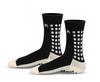
Because cleats won't change their design, protection has to come from what you wear inside them. MediCaptain's metatarsal ShockPad is a targeted cushion positioned over exactly this region, engineered to absorb and disperse impact from cleats and studs and reduce the force reaching the bone. It's the only athletic sock on the market that builds protection into the metatarsal area. The same principle that makes shin guards effective — spreading impact force over more time and area to lower the peak — applies here.
Biomechanical analysis confirms shin guards attenuate the force of impact to the tibia and reduce injury risk by spreading impact force over a longer time period, lowering the peak force. [Source: An analysis and comparison of soccer shin guards, PubMed (1995); BJSM (1999)]
WHEN TO SEE A PROFESSIONAL
Padding reduces impact, but it isn't a substitute for medical care. If you have persistent pain on the top of the foot, pain that worsens with activity, visible swelling that doesn't settle, or an inability to bear weight, see a healthcare professional. Metatarsal stress injuries in particular respond far better to early diagnosis than to playing through them.
FREQUENTLY ASKED QUESTIONS
Q: How do I know if my metatarsal is bruised or broken?
A: Bruises are painful and tender but usually allow weight-bearing; fractures typically cause severe pain, significant swelling, and difficulty walking. Only imaging can confirm a fracture, so see a professional if pain is severe or persistent.
Q: Can a sock really protect my metatarsals?
A: A sock with targeted padding over the metatarsal region reduces the impact force reaching the bone from cleats and studs. It reduces risk and pain from impact; it doesn't make the foot invincible.
Q: Why don't cleats protect the top of the foot?
A: Cleat uppers are intentionally thin for ball feel and control. That design choice leaves the metatarsal area with minimal padding against impact.
Q: How long does a metatarsal bruise take to heal?
A: Mild contusions often settle within days to a couple of weeks, but this varies. Protecting the area from repeat impact during healing helps; persistent pain warrants medical assessment.
MediCaptain — trusted by 100,000+ players. The only grip sock brand with built-in ankle cushioning and metatarsal ShockPad protection. Shop the collection at themedicaptain.com