
THE SHORT ANSWER
The most common soccer injuries are concentrated in the lower body: ankle sprains, hamstring strains, knee injuries, and contact injuries to the shin and foot. Ankle sprains sit at or near the top of nearly every epidemiological study. You can't eliminate injury risk in a contact sport, but you can meaningfully reduce it through preparation, technique, and the right protective gear.
ANKLE SPRAINS: THE NUMBER-ONE PROBLEM
Ankle sprains dominate soccer injury data.
Ankle sprains account for roughly 77% of all soccer-related ankle injuries, and soccer carries a reported injury rate of 13–35 injuries per 1,000 player-hours in competitive play. [Source: Risk Factors of Ankle Sprain in Soccer Players: A Systematic Review and Meta-Analysis, PMC (2024)]
They're also stubbornly recurrent, and fatigue is a major factor — a large share happen late in each half.
Nearly half (47%) of ankle sprains in Brazilian professional soccer occurred in the final 15 minutes of each half, and injuries recurred in over 31% of cases. [Source: Ankle Sprains in Brazilian Professional Soccer: 126,357 Match Hours, PMC (2024)]
Practical risk reduction: balance and proprioception training, taping or bracing for players with prior sprains, and cushioned ankle protection to absorb the contact impacts that cause contusions and bruising around the ankle bones.
CONTACT INJURIES TO THE SHIN AND FOOT
Soccer is a collision sport at the lower leg. Getting stepped on or catching a stud is routine, and it produces contusions, abrasions, and — less often but more seriously — fractures.
Fractures represent between 2–11% of all soccer injuries, and lower-extremity fractures account for 30–33% of all fractures sustained in the game. [Source: Soccer Shin Protection review, citing BJSM (1996)]
This is exactly what shin guards and foot padding address. Shin guards are proven to cut the force reaching the tibia.
In drop-track impact testing of 23 commercial shin guards on a calibrated synthetic tibia, guards reduced load forces by 41.2–77.1%, and provided significant protection against tibia fracture at every drop height. [Source: Francisco et al., Comparison of Soccer Shin Guards in Preventing Tibia Fracture, American Journal of Sports Medicine (2000)]
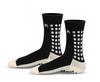
For the top of the foot — the metatarsal region — standard socks offer nothing, which is the gap MediCaptain's metatarsal ShockPad is designed to fill.
NON-CONTACT INJURIES: HAMSTRINGS AND KNEES
Not every injury comes from contact. Hamstring strains and knee injuries (including ACL injuries) often occur during sprinting, decelerating, or changing direction — which players do constantly.
Soccer players change direction on average roughly every six seconds during a match, loading the lower limbs — especially the ankle and foot — repeatedly. [Source: Ankle Sprains in Brazilian Professional Soccer, PMC (2024)]
These are best addressed through structured warm-ups, eccentric strength work (like Nordic hamstring curls), and neuromuscular training programs. Gear plays a smaller role here; preparation is everything.
A SIMPLE RISK-REDUCTION CHECKLIST
Warm up properly and progressively. Build lower-body and core strength in the off-field program. Wear well-fitted shin guards every session, not just matches. Use grip socks to reduce in-boot slippage and the friction it causes. Add cushioned foot and ankle protection if you play a contact-heavy position. Manage fatigue — many injuries cluster late in halves. And respect recovery between sessions.
FREQUENTLY ASKED QUESTIONS
Q: What is the most common injury in soccer?
A: Ankle sprains are consistently the most common, making up a large share of all injuries and around 77% of soccer-related ankle injuries specifically.
Q: Can gear actually reduce injury risk?
A: For impact and contact injuries, yes — shin guards measurably reduce force to the tibia, and padding reduces impact to protected areas. Non-contact injuries like hamstring strains are better addressed through strength and warm-up programs.
Q: Why do so many injuries happen late in the game?
A: Fatigue degrades coordination and reaction time. Studies find a notable share of ankle sprains occur in the final 15 minutes of each half.
Q: Do grip socks help prevent injuries?
A: Grip socks reduce in-boot slippage and the friction that causes blisters and hotspots. Padded versions also reduce impact to the foot's high-contact areas. They reduce specific risks rather than eliminating injury.
MediCaptain — trusted by 100,000+ players. The only grip sock brand with built-in ankle cushioning and metatarsal ShockPad protection. Shop the collection at themedicaptain.com