
THE SHORT ANSWER
Blisters aren't simply caused by your sock 'rubbing.' They're caused by repetitive shear — layers of skin being forced sideways against each other, over and over. The three ingredients are bone motion, high friction force, and repetition. Reduce any one of them and you reduce blisters. That's why locking your foot in place, managing moisture, and choosing the right sock construction all work.
THE REAL CAUSE: SHEAR, NOT RUBBING
This is the single most misunderstood thing about blisters.
Friction blisters are not caused by simple rubbing but by repetitive shear deformation within the skin, driven by bone motion, high friction force, and repetition. [Source: Friction Blisters of the Feet: A New Paradigm to Explain Causation, PMC / National Athletic Trainers' Association (2024)]
When your foot slides inside your boot during a sprint or cut, the skin surface stays gripped to the sock while the bone moves beneath it — that internal sliding is the shear that tears skin layers apart and forms a blister. So the most effective intervention is stopping the slide.
WHY MOISTURE MAKES IT WORSE
Sweat is not a bystander.
Increased heat raises moisture on the foot, which increases the friction force inside the shoe and raises blister risk — making moisture management central to blister reduction. [Source: Friction Blisters of the Feet: A New Paradigm, PMC (2024)]
A hot, damp foot generates more friction against the sock, which increases the shear cycles that cause blisters. Moisture-wicking, breathable fabric keeps the foot drier and lowers that friction — which is why fabric choice matters as much as fit.
WHAT SOCK CONSTRUCTION DOES
Research is clear that how a sock is built matters more than what it's made of.
Laboratory tribology shows knit structure and stitch density influence friction more than fiber type — shifting from a terry to a single-jersey architecture cut dynamic friction by roughly 15–30%. [Source: Cutaneous Friction Injuries and Blister Prevention in Athletes: A Systematic Review, Premier Science (2026)]
Denser, better-constructed socks manage moisture and absorb shear more effectively. Double-layer systems reduce skin-to-skin shear by letting the sock layers slide against each other instead of your skin.
In a controlled military study, a dense double-sock system reduced overall blister incidence to 40% versus 69% in a standard single-sock group, and halved severe cases. [Source: Knapik et al., cited in Cutaneous Friction Injuries and Blister Prevention in Athletes, Premier Science (2026)]
And modeling shows that a sock with low friction against the skin reduces the plantar shear that forms blisters.
Finite-element modeling of the foot-sock-insole interface found that socks with low friction against the skin more effectively reduced plantar shear force. [Source: Dai et al., cited in Friction Blisters on the Feet: A Critical Assessment of Current Prevention Strategies, PMC (2023)]
HOW GRIP SOCKS FIT INTO THIS
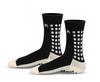
This is the counterintuitive part: a grip sock grips the boot, not your skin. By locking the sock-to-insole interface, it stops your foot from sliding inside the cleat — removing the bone motion that drives shear. Combined with moisture-wicking fabric, that's a direct attack on two of the three blister ingredients. MediCaptain grip socks use dual-sided grip to hold the foot in place and breathable fabric to keep it dry, which is why players routinely report far fewer blisters after switching.
A PRACTICAL ANTI-BLISTER ROUTINE
Wear properly fitted grip socks in your cleat size. Keep feet dry — change damp socks, and consider moisture-wicking fabrics over cotton. Break in new cleats gradually. Address hotspots the moment you feel them, before they blister. And if you're prone to blisters in specific spots, targeted taping or dressings add a second line of defense.
FREQUENTLY ASKED QUESTIONS
Q: What actually causes soccer blisters?
A: Repetitive shear inside the skin — driven by your foot sliding in the boot, high friction, and repetition. It's not the sock simply rubbing the surface.
Q: Do grip socks prevent blisters?
A: Grip socks reduce blister risk by locking your foot to the insole, which removes the internal sliding (shear) that forms blisters. Paired with moisture-wicking fabric, they address the main drivers.
Q: Are cotton socks bad for blisters?
A: Cotton holds moisture, and a damp foot generates more friction. Moisture-wicking synthetic or blended socks keep the foot drier, which lowers friction and shear.
Q: Should I use two pairs of socks?
A: Double-layer systems can reduce skin-to-skin shear and have been shown to lower blister incidence. A well-built grip sock achieves a similar effect by stopping the foot from sliding in the first place.
MediCaptain — trusted by 100,000+ players. The only grip sock brand with built-in ankle cushioning and metatarsal ShockPad protection. Shop the collection at themedicaptain.com