
THE SHORT ANSWER
Getting stepped on is routine in soccer because 22 players contest the same ball in tight spaces, changing direction constantly and planting studs unpredictably. The top of the foot — the metatarsal region — takes the worst of it, and cleats offer it almost no protection. Reducing the damage means adding cushioning over that specific area.
WHY IT HAPPENS SO OFTEN
Soccer packs enormous amounts of foot traffic into small spaces. Players change direction roughly every six seconds, planting and pivoting near opponents' feet.
Soccer players change direction on average roughly every six seconds during a match, loading the lower limbs — especially the ankle and foot — repeatedly. [Source: Ankle Sprains in Brazilian Professional Soccer, PMC (2024)]
In that environment, studs land on feet constantly — during tackles, in scrambles, at set pieces. It's not bad luck; it's the nature of the game. And most contact injuries in the lower limb come from exactly this kind of player-to-player contact.
In a two-year study of amateur players, 80.6% of ankle sprains were contact injuries, occurring most often in defenders, with 61.1% happening toward the end of each half as fatigue set in. [Source: Ankle sprain injuries and risk factors in amateur soccer players, PubMed (2007)]
WHY THE FOOT IS SO EXPOSED
The cleat is the problem and can't be the solution. Its upper is deliberately thin for ball feel, leaving the metatarsals — the bones across the top of the foot — with essentially no padding.
In a ten-year NCAA analysis, the four most common ankle injuries — lateral ligament tears, high ankle sprains, contusions, and deltoid tears — accounted for 95% of all ankle injuries; contusions from contact alone made up about 10%. [Source: Ten-Year Epidemiology of Ankle Injuries in Men's and Women's Collegiate Soccer, PubMed (2019)]
So when a stud lands on top of your foot, the force goes almost straight to bone. That's why a stomp that looks minor can leave you limping.
HOW PLAYERS REDUCE THE IMPACT
Since the cleat won't protect you, protection has to come from inside it.
Biomechanical analysis confirms shin guards attenuate the force of impact to the tibia and reduce injury risk by spreading impact force over a longer time period, lowering the peak force. [Source: An analysis and comparison of soccer shin guards, PubMed (1995); BJSM (1999)]
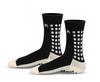
The same principle that makes shin guards work — spreading impact over more time and area to lower the peak force — applies to foot padding. MediCaptain's metatarsal ShockPad is a targeted cushion over the top of the foot, engineered to absorb and disperse stud and cleat impact before it reaches the bone. It's the only athletic sock that builds this protection in, and combined with cushioned ankle dots, it covers the two areas most likely to get stepped on.
WHAT TO DO WHEN IT HAPPENS
Padding reduces impact, but hard contact still warrants attention. If you take a heavy stomp and have persistent pain, swelling, or trouble bearing weight, get it assessed — the top of the foot is a common site for bruises and, occasionally, fractures. Protecting the area during play reduces the everyday knocks; medical care handles the serious ones.
FREQUENTLY ASKED QUESTIONS
Q: Why does the top of my foot hurt after soccer?
A: Often from getting stepped on — the metatarsal region takes direct stud and cleat contact, and cleats offer it little padding, so impacts go nearly straight to bone, causing bruising.
Q: How can I protect the top of my foot in soccer?
A: Targeted cushioning over the metatarsal area, like a metatarsal ShockPad sock, absorbs and disperses stud impact. Cleats can't provide this because their uppers are thin for ball feel.
Q: Is getting stepped on dangerous?
A: Usually it causes bruising, but hard contact can cause fractures. Persistent pain, swelling, or trouble bearing weight after a stomp should be assessed by a professional.
Q: Do any socks protect against being stepped on?
A: MediCaptain's padded grip sock is the only athletic sock with built-in metatarsal protection, designed to reduce the impact from cleat and stud contact to the top of the foot.
MediCaptain — trusted by 100,000+ players. The only grip sock brand with built-in ankle cushioning and metatarsal ShockPad protection. Shop the collection at themedicaptain.com