
THE SHORT ANSWER
Surface changes the demands on your feet and lower legs. Grass and turf grip differently, which affects how your foot plants, slides, and absorbs force. The constant across surfaces is that reducing in-boot slippage and cushioning impact-prone areas helps — because on any surface, the foot sliding inside the cleat and taking stud contact are what cause problems.
HOW SURFACES DIFFER UNDERFOOT
Grass and modern turf behave differently in traction, hardness, and how the foot releases during a pivot. Those differences influence loading on the ankle, knee, and foot. What doesn't change is the fundamental biomechanical challenge: soccer requires constant, rapid direction changes that load the lower limb.
Soccer players change direction on average roughly every six seconds during a match, loading the lower limbs — especially the ankle and foot — repeatedly. [Source: Ankle Sprains in Brazilian Professional Soccer, PMC (2024)]
Every cut and plant is a moment where traction and foot stability matter, regardless of what's under your cleats.
THE SLIPPAGE FACTOR
On any surface, if your foot slides inside your boot during a plant, you lose control and generate the shear that causes blisters.
Friction blisters are not caused by simple rubbing but by repetitive shear deformation within the skin, driven by bone motion, high friction force, and repetition. [Source: Friction Blisters of the Feet: A New Paradigm to Explain Causation, PMC / National Athletic Trainers' Association (2024)]
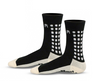
Turf's grippier release can make in-boot slippage even more noticeable, because your cleat may hold while your foot keeps moving. Grip socks address this directly by locking the foot to the insole so the whole system moves together.
IMPACT AND CONTACT ARE SURFACE-INDEPENDENT
One thing turf and grass share: players still get stepped on and tackled on both.
In a two-year study of amateur players, 80.6% of ankle sprains were contact injuries, occurring most often in defenders, with 61.1% happening toward the end of each half as fatigue set in. [Source: Ankle sprain injuries and risk factors in amateur soccer players, PubMed (2007)]
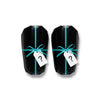
The contact injuries to the ankle and foot that dominate soccer injury data happen on every surface. That's why cushioned ankle and metatarsal protection is valuable whether you play on a grass pitch or a turf field — the studs land on your feet either way.
PRACTICAL TAKEAWAYS
Match your cleats to the surface (firm ground vs. turf soles) for appropriate traction. Use grip socks to control in-boot slippage, which turf can accentuate. Keep feet dry to manage friction. And wear impact protection for the contact that happens regardless of surface. The surface changes the details; the fundamentals of foot stability and protection carry across both.
FREQUENTLY ASKED QUESTIONS
Q: Is turf more dangerous than grass for soccer?
A: Surfaces differ in traction and hardness, which changes loading on the joints and feet. Both carry injury risk; the key is appropriate footwear for the surface plus foot stability and protection.
Q: Do I need different socks for turf?
A: The same grip and protection priorities apply. Grip socks are arguably even more useful on turf, where a grippier surface can make in-boot foot slippage more noticeable.
Q: Why do my feet slide more on turf?
A: Turf can grip your cleat firmly while your foot continues moving inside the boot, accentuating in-boot slippage. Grip socks lock the foot to the insole to reduce this.
Q: Does surface affect getting stepped on?
A: No — contact injuries from tackles and stomps happen on both turf and grass, which is why foot and ankle protection is valuable on any surface.
MediCaptain — trusted by 150,000+ players. The only grip sock brand with built-in ankle cushioning and metatarsal ShockPad protection. Shop the collection at themedicaptain.com