
THE SHORT ANSWER
True ankle protection in a sock requires cushioned padding positioned specifically over the ankle bones — thick enough to absorb stud and cleat impact, but thin enough that it doesn't affect fit inside your cleat. Most socks offer none of this. The best ankle-protection socks in 2026 combine that targeted cushioning with grip and moisture-wicking fabric.
WHY ANKLE CONTUSIONS ARE SO COMMON
When people think 'ankle injury' they think sprains, but bruises and contusions from direct contact are a daily reality.
In a ten-year NCAA analysis, the four most common ankle injuries — lateral ligament tears, high ankle sprains, contusions, and deltoid tears — accounted for 95% of all ankle injuries; contusions from contact alone made up about 10%. [Source: Ten-Year Epidemiology of Ankle Injuries in Men's and Women's Collegiate Soccer, PubMed (2019)]
These aren't always dramatic — they're the nagging, painful knocks from cleats and studs that accumulate over a season and make you hesitant going into challenges. That accumulation is exactly what targeted ankle cushioning addresses.
WHAT REAL ANKLE PROTECTION LOOKS LIKE
Padding has to be in the right place to matter. It needs to sit over the medial and lateral ankle bones — the prominences that take direct contact — without bulking up the whole sock and ruining cleat fit.
Biomechanical analysis confirms shin guards attenuate the force of impact to the tibia and reduce injury risk by spreading impact force over a longer time period, lowering the peak force. [Source: An analysis and comparison of soccer shin guards, PubMed (1995); BJSM (1999)]
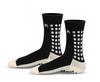
MediCaptain's grip socks use padded dots strategically placed on the ankle area to cushion impact while keeping the sock slim. Combined with the metatarsal ShockPad on the top of the foot, that's among the most comprehensive foot-and-ankle protection available in a soccer sock.
WHAT TO COMPARE WHEN BUYING
|
Feature |
Why it matters |
|
Padding placement |
Must sit over the ankle bones to protect the actual impact zone |
|
Padding profile |
Thin enough not to disrupt cleat fit or ankle mobility |
|
Grip |
Locks the foot to reduce slippage and awkward plants |
|
Moisture-wicking |
Keeps the foot dry, lowering friction and blister risk |
|
Durability |
Padding and grip should survive repeated washing |
PROTECTION IS A LAYER, NOT A CURE
Cushioned socks reduce impact from contact — they don't stabilize a loose ankle or prevent ligament sprains. For players with instability or a sprain history, cushioning is one layer alongside balance training and, where appropriate, bracing. Think of ankle-protection socks as reducing the everyday knocks and contusions, while training addresses the bigger sprain risk.
FREQUENTLY ASKED QUESTIONS
Q: Can socks protect your ankles in soccer?
A: Socks with cushioned padding over the ankle bones reduce the impact from cleat and stud contact that causes contusions and bruising. They reduce impact injuries but don't stabilize the ankle against sprains.
Q: Where should ankle padding be positioned?
A: Over the medial and lateral ankle bones — the bony prominences that take direct contact. Padding elsewhere on the sock doesn't protect the actual impact zone.
Q: Do padded socks fit in cleats okay?
A: Well-designed ankle-protection socks keep the padding thin and targeted so it cushions impact without disrupting cleat fit or ankle mobility.
Q: Are ankle-protection socks a substitute for a brace?
A: No. Cushioned socks reduce impact from contact; braces address instability and sprain risk. Players with a sprain history may need both, guided by a professional.
MediCaptain — trusted by 100,000+ players. The only grip sock brand with built-in ankle cushioning and metatarsal ShockPad protection. Shop the collection at themedicaptain.com