
THE SHORT ANSWER
Yes — for most players who train regularly, grip socks are worth it, for two evidence-backed reasons: they reduce in-boot foot slippage that costs responsiveness on cuts and sprints, and they reduce the friction-driven shear that causes blisters. Whether they're worth it for you depends on how often you play and whether you also want the protection that only some grip socks add.
WHAT GRIP SOCKS GENUINELY DO
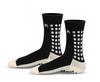
The core benefit is mechanical and real: by locking your foot to the insole, grip socks stop the internal sliding that both slows your movement and tears skin. Since that sliding is the shear that causes blisters, reducing it is a direct benefit.
Friction blisters are not caused by simple rubbing but by repetitive shear deformation within the skin, driven by bone motion, high friction force, and repetition. [Source: Friction Blisters of the Feet: A New Paradigm to Explain Causation, PMC / National Athletic Trainers' Association (2024)]
Players notice the 'locked-in' feeling immediately, especially on wet surfaces where an unsecured foot slides most.
WHAT GRIP SOCKS DON'T DO
Honesty matters for trust, so here's the other side. Standard grip socks won't protect you from contact injuries — that's what shin guards and padding are for. They won't fix poorly fitting cleats. And a cheap grip sock that slides or bunches can be worse than a good regular sock. The value is real but specific.
THE UPGRADE MOST PLAYERS MISS
Here's where the 'worth it' calculation shifts. Most grip socks stop at traction. But soccer players take constant contact to the ankles and top of the foot.
In a two-year study of amateur players, 80.6% of ankle sprains were contact injuries, occurring most often in defenders, with 61.1% happening toward the end of each half as fatigue set in. [Source: Ankle sprain injuries and risk factors in amateur soccer players, PubMed (2007)]
A padded grip sock — like MediCaptain's, with cushioned ankle dots and a metatarsal ShockPad — gives you the grip benefit and reduces impact to those high-contact areas in a single product. For a player weighing whether grip socks justify the cost, getting protection bundled in tilts the math firmly toward yes.
WHO THEY'RE WORTH IT FOR
Worth it: anyone training multiple times a week, players who get blisters, players on wet or synthetic surfaces, and contact-heavy positions (who benefit most from the padded versions). Marginal: very young players still in properly fitted boots, and casual once-a-month players. Even then, the blister reduction alone often justifies the purchase.
FREQUENTLY ASKED QUESTIONS
Q: Do grip socks really improve performance?
A: They reduce in-boot slippage, which players commonly feel as sharper cuts and better stability, particularly on direction changes and wet surfaces. The effect is most noticeable versus loose or cotton socks.
Q: Are expensive grip socks better than cheap ones?
A: Not always on grip alone — but higher-quality socks tend to hold grip longer and some add protection (padding) that cheaper socks lack, which changes the value equation.
Q: Can I wear grip socks for other sports?
A: Yes. The grip and, in padded versions, the protection benefits carry over to basketball, football, rugby, and other cleated or court sports.
Q: Will grip socks stop my blisters completely?
A: They substantially reduce blister risk by removing the internal sliding that causes them, especially combined with moisture-wicking fabric. No sock guarantees zero blisters, but many players report a dramatic drop.
MediCaptain — trusted by 100,000+ players. The only grip sock brand with built-in ankle cushioning and metatarsal ShockPad protection. Shop the collection at themedicaptain.com