
THE SHORT ANSWER
The best mini shin guards balance three things: enough impact protection to matter, a low profile that players actually want to wear, and secure fit so they stay put. Mini guards became popular because players prefer their light, unrestrictive feel — but the trade-off is coverage, so fit and secure retention are critical to getting real protection from a small guard.
DO MINI SHIN GUARDS ACTUALLY PROTECT YOU?
This is the honest question. Full-size shin guards are proven to dramatically reduce force to the tibia.
In drop-track impact testing of 23 commercial shin guards on a calibrated synthetic tibia, guards reduced load forces by 41.2–77.1%, and provided significant protection against tibia fracture at every drop height. [Source: Francisco et al., Comparison of Soccer Shin Guards in Preventing Tibia Fracture, American Journal of Sports Medicine (2000)]
The protective mechanism is spreading impact over more time and area to lower the peak force reaching the bone.
Biomechanical analysis confirms shin guards attenuate the force of impact to the tibia and reduce injury risk by spreading impact force over a longer time period, lowering the peak force. [Source: An analysis and comparison of soccer shin guards, PubMed (1995); BJSM (1999)]
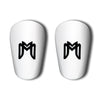
A mini guard uses the same principle over a smaller area. It covers less of the shin, so it protects the central impact zone rather than the whole leg. The key is that within its coverage area, a well-built mini guard still absorbs and disperses impact. It's a deliberate trade of coverage for comfort — and for many players, a guard they'll actually keep on beats a bigger one they push down or remove.
WHAT TO LOOK FOR
|
Factor |
Why it matters |
What to look for |
|
Shell material |
Determines impact dispersion |
Hard outer shell over foam liner |
|
Retention |
A guard that slides can't protect |
Sleeve or strap system, not loose insert |
|
Weight/profile |
Drives whether you keep it on |
Lightweight, low-profile design |
|
Compliance |
Refs check for guards |
Meets your league's requirements |
|
Fit |
Coverage over the impact zone |
Sized to your shin, sits centered |
THE RETENTION PROBLEM — AND THE FIX
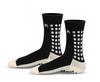
A mini guard's biggest weakness is staying in place. A small guard that slides down mid-game leaves the impact zone exposed. That's why the retention system matters as much as the guard. MediCaptain offers mini guards with built-in sleeves that hold the guard over the shin, plus silicone shin guard straps for players who prefer their own sleeves. The combination keeps the guard centered on the impact zone where it does its job.
WHO MINI GUARDS ARE BEST FOR
Mini guards suit skill players who prioritize freedom of movement and have historically pushed bulky guards down or 'forgotten' them. They're popular in higher-level and adult play. For very young players or those in high-contact defensive roles, a larger guard's extra coverage may be the better call. The best guard is ultimately the one a player will wear correctly every match — which is exactly why the minimal, comfortable design has taken off.
FREQUENTLY ASKED QUESTIONS
Q: Are mini shin guards legal?
A: Rules vary by league and level. Many leagues require shin guards that provide 'reasonable protection' without specifying size, but some youth leagues have specific requirements. Always check your league's rules before matches.
Q: Do mini shin guards protect enough?
A: Within their coverage area, a well-built mini guard absorbs and disperses impact using the same mechanism as full guards. They trade total coverage for comfort, protecting the central impact zone. Fit and retention are essential to that protection.
Q: How do I keep mini shin guards from sliding down?
A: Use a guard with a built-in sleeve or a dedicated shin guard strap. A loose guard tucked into a sock will migrate; a sleeve or strap holds it over the impact zone.
Q: Why do pros wear tiny shin guards?
A: Many higher-level players prefer minimal guards for freedom of movement and ball feel. The priority is a guard they'll wear correctly and comfortably every match over maximum coverage.
MediCaptain — trusted by 100,000+ players. The only grip sock brand with built-in ankle cushioning and metatarsal ShockPad protection. Shop the collection at themedicaptain.com