
THE SHORT ANSWER
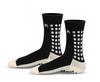
Regular soccer socks cover your leg and hold your shin guard; grip socks add anti-slip pads that lock your foot to the boot's insole. The practical difference is that grip socks stop your foot sliding inside the cleat — improving responsiveness and cutting the friction that causes blisters. Many players wear both: a grip sock for performance and a team sock over it for uniform compliance.
TRACTION: THE CORE DIFFERENCE
A standard sock lets your foot move inside the boot, especially when sweat or rain makes things slick. That movement is the enemy: it costs responsiveness and, because the sliding creates shear in the skin, it drives blisters.
Friction blisters are not caused by simple rubbing but by repetitive shear deformation within the skin, driven by bone motion, high friction force, and repetition. [Source: Friction Blisters of the Feet: A New Paradigm to Explain Causation, PMC / National Athletic Trainers' Association (2024)]
Grip socks add silicone or rubberized pads that grip the insole and hold your foot in place through cuts, sprints, and sudden stops.
BLISTERS AND MOISTURE
Regular cotton team socks tend to hold moisture, and a damp foot generates more friction and more blisters.
Increased heat raises moisture on the foot, which increases the friction force inside the shoe and raises blister risk — making moisture management central to blister reduction. [Source: Friction Blisters of the Feet: A New Paradigm, PMC (2024)]
Performance grip socks are typically built from moisture-wicking synthetic blends that keep the foot drier. Combined with the anti-slip grip, that's a two-front reduction in blister risk that regular socks don't offer.
PROTECTION: WHERE THE GAP IS BIGGEST
Neither a regular sock nor a basic grip sock protects the foot from impact — with one exception. Soccer players take repeated contact to the ankle and metatarsal, and standard socks do nothing about it.
In a ten-year NCAA analysis, the four most common ankle injuries — lateral ligament tears, high ankle sprains, contusions, and deltoid tears — accounted for 95% of all ankle injuries; contusions from contact alone made up about 10%. [Source: Ten-Year Epidemiology of Ankle Injuries in Men's and Women's Collegiate Soccer, PubMed (2019)]
MediCaptain's padded grip sock is the outlier: it adds cushioned ankle dots and a metatarsal ShockPad, so you get traction and impact reduction that no regular sock provides.
SIDE-BY-SIDE
|
Feature |
Regular Soccer Sock |
Grip Sock |
Padded Grip Sock (MediCaptain) |
|
Holds shin guard |
Yes |
Sometimes |
Pair with sleeve |
|
Anti-slip grip |
No |
Yes |
Yes (dual-sided) |
|
Moisture-wicking |
Varies |
Usually |
Yes |
|
Foot/ankle protection |
No |
No |
Yes |
|
Uniform compliant alone |
Yes |
Not always |
Pair with sleeve |
SO WHICH SHOULD YOU WEAR?
For matches, many players wear a grip sock underneath and pull the team sock (or a pre-cut sleeve) over the top to stay compliant. For training, a grip sock alone is ideal. If you want protection as well as grip, a padded grip sock replaces two products with one.
FREQUENTLY ASKED QUESTIONS
Q: Can I wear grip socks instead of team socks?
A: For training, yes. For matches, uniform rules usually require team socks, so most players wear a grip sock underneath and a team sock or pre-cut sleeve over it.
Q: Are grip socks better than regular socks?
A: For performance and blister reduction, yes — they lock the foot in place and wick moisture. Regular socks still matter for covering the shin guard and meeting uniform rules.
Q: Do grip socks hold shin guards?
A: Some do, but many players use a pre-cut sleeve sock or shin guard straps to hold guards, paired with the grip sock underneath.
Q: Why are my regular socks giving me blisters?
A: Likely a combination of foot sliding inside the boot and moisture buildup — both increase the shear that causes blisters. Grip socks address both.
MediCaptain — trusted by 100,000+ players. The only grip sock brand with built-in ankle cushioning and metatarsal ShockPad protection. Shop the collection at themedicaptain.com