
THE SHORT ANSWER
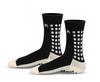
There's a real trade-off between cushioning and ball feel: thicker padded socks protect impact-prone areas but slightly reduce the tactile connection to the ball, while thinner socks maximize feel but offer less protection. Defenders and keepers should lean toward protection; midfielders and wingers toward feel; most players land on a medium-weight sock that does both.
DEFENDERS: PROTECTION FIRST
Defenders live in the contact zone — hard tackles, blocked shots, tangled feet, and stud contact. The data bears this out: contact ankle injuries occur most often in defenders.
In a two-year study of amateur players, 80.6% of ankle sprains were contact injuries, occurring most often in defenders, with 61.1% happening toward the end of each half as fatigue set in. [Source: Ankle sprain injuries and risk factors in amateur soccer players, PubMed (2007)]
For this role, prioritize a padded grip sock with cushioned ankle dots and metatarsal protection. The slight reduction in ball feel is a worthwhile trade for reducing the impacts you take every match.
GOALKEEPERS: STABILITY AND IMPACT
Keepers need secure footing for lateral dives and quick line movement, plus impact absorption for diving saves on hard ground. A cushioned grip sock helps on both counts — grip for stable footwork, padding to absorb impact. The added padding is worth the small reduction in ground feel for a position that isn't striking the ball at range.
MIDFIELDERS AND WINGERS: FEEL AND GRIP
These players want the close tactile connection to the ball for first touch, passing, and finishing, plus grip for the constant direction changes.
Soccer players change direction on average roughly every six seconds during a match, loading the lower limbs — especially the ankle and foot — repeatedly. [Source: Ankle Sprains in Brazilian Professional Soccer, PMC (2024)]
A thinner grip sock gives them the feel they want while still locking the foot in place. If they play a physical, box-to-box role, a medium-weight option adds some protection without much feel penalty.
QUICK REFERENCE
|
Position |
Priority |
Recommended |
|
Defender |
Impact protection |
Padded grip sock (ankle + metatarsal) |
|
Goalkeeper |
Stability + impact |
Cushioned grip sock |
|
Midfielder |
Feel + grip |
Medium-weight grip sock |
|
Winger / Forward |
Ball feel + grip |
Thinner grip sock |
THE UNIVERSAL TRUTH
Whatever your position, two things are constant: the sock must lock your foot to the boot, and it must manage moisture to control friction. Everything else — how much padding, how thin the knit — flexes around your role and preference. Many players own two pairs: a padded pair for matches and a thinner pair for technical training.
FREQUENTLY ASKED QUESTIONS
Q: Do defenders need different grip socks than forwards?
A: Defenders benefit from more protection because they take the most contact, while forwards often prefer thinner socks for ball feel. The grip requirement is universal; the padding level flexes by role.
Q: What grip socks do goalkeepers wear?
A: Keepers benefit from cushioned grip socks that provide stable footing for dives and lateral movement plus impact absorption on hard landings.
Q: Does sock thickness affect ball control?
A: Slightly. Thicker socks reduce tactile feel a little; thinner socks maximize it but offer less protection. Medium-weight socks balance the two for most players.
Q: Can one grip sock work for any position?
A: A medium-weight padded grip sock is a strong all-rounder. Specialists (technical forwards vs. physical defenders) may prefer to optimize for feel or protection respectively.
MediCaptain — trusted by 100,000+ players. The only grip sock brand with built-in ankle cushioning and metatarsal ShockPad protection. Shop the collection at themedicaptain.com