
THE SHORT ANSWER
Ankle sprains are the single most common soccer injury, most often caused by contact — landing on another player's foot, being tackled, or an awkward plant during a cut. They're also highly recurrent, which is why the biggest wins come from balance training, appropriate bracing or taping for players with a history, and cushioning to reduce the contact impacts that cause bruising around the ankle.
JUST HOW COMMON ARE THEY?
The numbers are striking.
Ankle sprains account for roughly 77% of all soccer-related ankle injuries, and soccer carries a reported injury rate of 13–35 injuries per 1,000 player-hours in competitive play. [Source: Risk Factors of Ankle Sprain in Soccer Players: A Systematic Review and Meta-Analysis, PMC (2024)]
And they make up a consistent share of total injuries across every level of play.
Ankle sprains represent 17–20% of all soccer injuries, at an incidence of 1.7–2.0 ankle injuries per 1,000 hours of exposure. [Source: Ekstrand & Tropp, The incidence of ankle sprains in soccer, PubMed (1990)]
If you play soccer long enough, the odds you'll roll an ankle at some point are high.
CONTACT, FATIGUE, AND POSITION
Most soccer ankle sprains aren't freak solo accidents — they're contact events.
In a two-year study of amateur players, 80.6% of ankle sprains were contact injuries, occurring most often in defenders, with 61.1% happening toward the end of each half as fatigue set in. [Source: Ankle sprain injuries and risk factors in amateur soccer players, PubMed (2007)]
Fatigue compounds it: coordination fades late in halves, and that's exactly when many sprains occur.
Nearly half (47%) of ankle sprains in Brazilian professional soccer occurred in the final 15 minutes of each half, and injuries recurred in over 31% of cases. [Source: Ankle Sprains in Brazilian Professional Soccer: 126,357 Match Hours, PMC (2024)]
Defenders, who make hard tackles and block shots, are especially exposed to the contact that causes both sprains and contusions.
THE RECURRENCE TRAP
The most important thing to understand about ankle sprains is that one sprain raises your risk of the next.
Nearly half (47%) of ankle sprains in Brazilian professional soccer occurred in the final 15 minutes of each half, and injuries recurred in over 31% of cases. [Source: Ankle Sprains in Brazilian Professional Soccer: 126,357 Match Hours, PMC (2024)]
A previously sprained ankle is more likely to be re-injured, which is why players with a history need targeted prevention — not just recovery — before returning to full play.
WHAT ACTUALLY REDUCES RISK
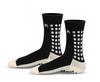
Evidence points to a few high-value interventions. Balance and proprioception training (wobble boards, single-leg work) rebuilds the neuromuscular control that prevents rolls. Bracing or taping benefits players with prior sprains most. Strength work around the ankle and hip improves stability. Managing fatigue and substitution timing matters given the late-half injury pattern. And cushioned ankle protection — like the padded dots on MediCaptain's grip socks — reduces the impact from the cleat and stud contact that causes ankle contusions and bruising, one of the most common day-to-day ankle complaints.
FREQUENTLY ASKED QUESTIONS
Q: How can I stop rolling my ankle in soccer?
A: Balance and proprioception training is the most evidence-backed step, plus strength work around the ankle. Players with prior sprains benefit from bracing or taping, and cushioning reduces the contact impacts that cause bruising.
Q: Why do I keep spraining the same ankle?
A: A previous sprain increases re-injury risk, often because neuromuscular control and stability haven't fully returned. Targeted rehab and prevention before full return are key to breaking the cycle.
Q: Can socks help with ankle sprains?
A: Grip socks reduce in-boot slippage that contributes to awkward plants, and cushioned ankle padding reduces the impact from contact that causes ankle contusions. They reduce specific risks; bracing and training address instability.
Q: When can I play after an ankle sprain?
A: Only after pain and swelling resolve and you've restored strength, range of motion, and balance — returning too early is a leading cause of recurrence. A healthcare professional should guide return-to-play.
MediCaptain — trusted by 100,000+ players. The only grip sock brand with built-in ankle cushioning and metatarsal ShockPad protection. Shop the collection at themedicaptain.com